Tuesday, 3 July 2012

Letting loose in La Paz

After an overnight bus from Uyuni we arrived in La Paz bright and early, and thanks to being at an altitude of 3650m it was nice and cold.  We'd bravely booked a week at the infamous Wild Rover hostel, so we jumped in a taxi to go check in.  However as it was only about 7:30/8am we were far too early to check in, although quite a few people we only just getting back to the hostel after a night out.  Daylight was not their friend.

We wandered around town for a while before checking in and having a nap, then Derek and Kelly came to our hostel bar for a few drinks that first night.  Kurt and I continued on til the wee smalls, so the next day was a bit of a struggle, especially for me.  We all met up again at an English pub (several hours later for me) then went to a local Sunday event in La Paz - Cholita wrestling, which is a group of female lucha libre wrestlers.  Cholitas are indigenous to the El Alto area of Bolivia where the wrestling takes place, and they have a distinctive look: they wear braided hair, bowler hats and multilayered skirts in everyday life and in the ring too.  Not your standard wrestling event.  We were there for about 3 hours and saw about 15 fights - men vs men, women vs women, men vs women including tag teams.  It was hilarious, especially the outfits.  Who knew Spongebob Squarepants was a wrestler?  We certainly didn't.  By the end of it all we were freezing cold and pretty over it, so were glad to get back to town.  It was definitely one of the more unique events we've been to though!


The highlight of our time in La Paz, and one of the best things we've done so far, was biking down the famous 'Death Road', the world's most dangerous road.  It's estimated that 200-300 people die on the 64km road every year, which means a fatal accident occurs approximately every two weeks. It's one of the few routes that connects the Amazon rainforest region of northern Bolivia to La Paz so that's why it's still used even though so many people have died over the years - there is simply no other choice.  And of course all this means that all the gringos who come to La Paz want to bike down the road and risk their lives - including us.  Only natural really.  We were smart about it though and chose a company that had a really good reputation for excellent equipment - good bikes with quality disc brakes and dual suspension, full helmet, jacket, pants and knee and elbow pads.  Not that any of this will save you if you go over the edge, but best to start out properly anyway.  We chose Vertigo Biking and they were actually cheaper than some of the other companies who had shittier equipment, so we were happy with them. 
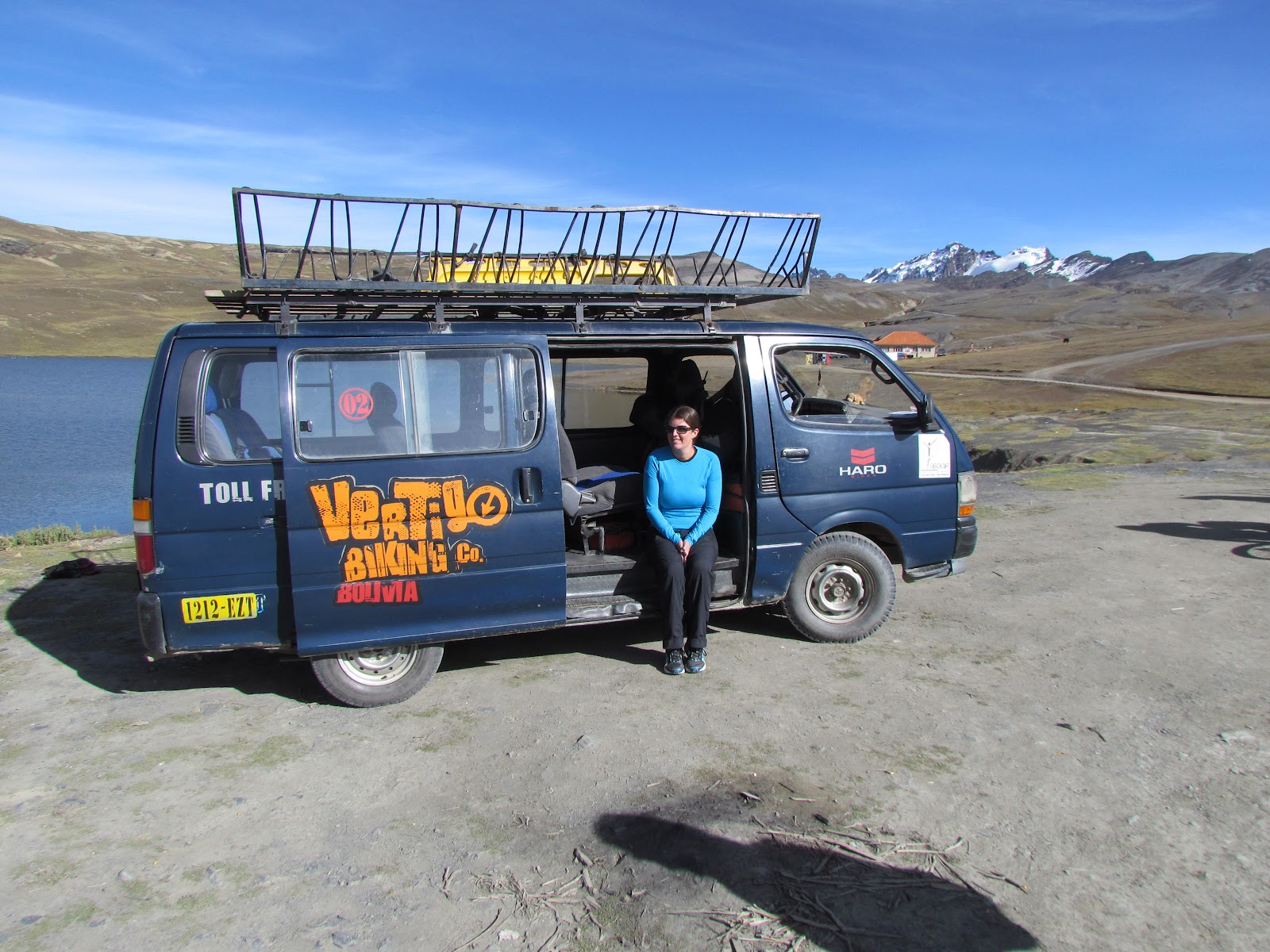


We did the tour with Derek and Kelly and we also met Blair, a crazy kiwi with ridiculous amounts of energy.  We had to drive out of town for about 25mins to the starting point, then the first downhill section was a nice wide paved road.  There was a bit of traffic and some slippery gravel at points though so we still had to pay attention.  Kurt and a couple of other guys took off and were racing one of the guides down so they were fair flying.  But luckily no one in our group came off.  Good start to proceedings.  At the end of this section we had to get back in the van and drive uphill to where the official gravel death road began.  The next two hours would be spent biking this single lane road no wider than about 3m.  And of course there are no guard rails so it's a sheer drop-off of at least 600m.  Luckily (I think) it was pretty foggy so we couldn't see the full extent of the drop-off, but you definitely know where the edge is!  It wasn't overly reassuring to see the crosses and memorials for tourists who've died while biking down though.  Our guide told us that on average one or two tourists die each year, and that there hadn't been any so far this year...thanks mate.  But we all managed to make it down to the bottom without anyone stacking it and it was the most fun we've had in ages.  Such an adrenalin rush and you actually forget how dangerous it is after a while.  Until you slide on some mud or come a bit too close to the edge that is!  When we'd all made it safely to the bottom we went to a restaurant for lunch and a shower, and a swim if we wanted.  Then we had a long uphill drive back to town with the worst mixture of music pumping out at full blast.  It's party time in La Paz no matter where you are.

The rest of our time in La Paz was pretty chilled out - well, after we checked out of the Wild Rover a few days early and moved to a nice quiet place across the road that is.  The final straw was when the guy on the bunk above me was in a bad state one night, moaning and groaning like he was dying.  Kurt kept yelling at him to shut the fuck up but he was too far gone to know what was going on.  Then he spewed against the wall which dribbled down onto my bed.  Thanks fuckstick, just what I wanted at 3am.  We did have another night out with another American couple, Rob and Melinda, at a bar run by Mick Jagger.  Well, an English guy that looked and acted exactly like him anyway. He even had his bandmates with him.
 
We also walked around San Pedro prison that's in the middle of town, and if any of you have read 'Marching Powder' you'll be familiar with it.  They no longer let gringos go inside on tours and stay overnight as talked about in the book, and they don't even let you stop and look in the front gate that stands wide open.  There's a plaza directly across the road so you can sit there and watch, but if you try and take photos the cops come over and make you delete them.  Kurt tried to get some from a shop on the other side of the plaza, but it was hard to get a good shot.  It's pretty insane to see this slap bang in the middle of the city though, as you can see through the main gate all the inmates just milling around in a courtyard inside.  They're obviously locked in but to see them so close is crazy.  And there's a steady stream of local people walking in and out, whether they're visiting or live there with their husband etc who knows.  Anything goes in Bolivia.


After 6 days in La Paz we were ready to move on.  So many people get stuck in this city so we were determined to escape the clutches of this party place before it was too late.  Luckily we're not still in our early 20s or it could have been a different story...

Sunday, 1 July 2012

Salar de Uyuni - all that was missing was tequila and lime

One of the things we'd been looking forward to doing in Bolivia was a tour of the world's largest salt flats (12,000km2) - Salar de Uyuni.  After reading a lot of blogs and reviews and talking to other travellers, we decided to start the tour in the south in a place called Tupiza and spend 4 days heading north to end in the salt flats just out of Uyuni.  The other alternative is to begin and end in Uyuni, but you don't get to see the variety of landscapes as we did starting from the south.  Another reason we opted for the Tupiza-Uyuni tour is because it finished with the salt flats rather than started them which makes more sense - you don't want the best thing over and done with first up.  That would just be silly.

Tupiza is quite a small town with a backdrop of red rock and barren hills surrounding it.  The most notable thing about this town is that Butch Cassidy and the Sundance Kid met their end at the hands of the Bolivian army not far from Tupiza.  We only stayed for a couple of days before we headed off on the tour.  As is always the issue with booking a tour, we had to decide which company to book with.  We'd read good reviews about a couple of companies, but in the end we went through the hostel we were staying at.  And it turned out pretty good because that was how we met Derek and Kelly, an American couple we became really good friends with.  Thank god, because 4 days in a jeep together would have been torture if they were dickheads!  We also lucked out with our driver, Emilio, who was an absolute legend.  He couldn't speak English but we all managed to communicate with our limited Spanish, and he was always willing to point things out and explain stuff.  He was the sweetest guy and we all got along like a house on fire.
 
Over the next four days we saw some amazing landscapes, and it blew us away how different it was not only from day to day, but sometimes from hour to hour.  On the first day alone we went from rocky mountain landscapes to rolling green hills with llamas frolicking about to snow-capped mountains.  It was impossible to get bored with the scenery.  


We spent the first night in a tiny village where we had time to walk around and see the local kids playing, or as two little girls preferred, just hanging out eating dirt.  We had a group of the kids entertain us over dinner with some local music and singing before we retired to our freezing cold room.  It was so cold we had to go to bed fully clothed in layers of thermals, jumpers, socks, beanie and gloves.  Plus a sleeping bag on top of the blankets.  And it definitely wasn't any warmer when we got up at 4am then next morning to set out before sunrise.  Our driver Emilio proved his awesomeness even more that morning by still being ready to go and with a smile on his face despite being knocked out the previous night when the boot lid fell and smashed him on the head.  What a trooper.
 
More spectacular scenery was to follow during the rest of the tour - some beautiful different coloured lagoons including a pink lagoon with pink flamingos, random rock formations, a geothermal pool in a snow blizzard, a train cemetery and finally, the piece de resistance , the salt flats themselves.


It was on the final morning that we were up at 4am again to get out on the flats to watch the sunrise.  It was one of the most surreal and bizarre landscapes we've ever seen - miles and miles of salt stretching as far as the eye can see.  It was a pretty amazing setting for sunrise and a picnic breakfast afterwards.  And surprisingly there were only a couple of other groups around in the distance. Then it was time to experiment with the perspective photos everyone does - it's one of those cliched things you just have to do.  However, we soon found out it was a lot harder than we expected getting things lined up.  But after playing around for a good hour or so, we all had some pretty good shots. 


Thankfully this tour wasn't a disappointment and we saw so much more than we bargained for.  An amazing 4 days.  And we made two good friends as a bonus...even if they are American ;)


Monday, 25 June 2012

Potosi - truly the place of the Devil's Miner

Arriving in Potosi after another overnight bus, it was immediately apparent we were in the world's highest city at 4070m.  Even before we got off the bus I started to feel a bit dodgy, and it only got worse.  Thankfully the English guys we met in Sucre had recommended a hostel to stay at, so we were able to get a taxi straight there instead of having to find one ourselves.  The beds weren't ready yet so we had to walk around for a while, so we got a nice cheap lunch and checked out the local market.  However, we both started feeling really lightheaded and struggling for breath, and it wasn't a pleasant feeling.  I only got worse and felt like absolute shit - hard to breathe, lightheaded, nauseous, whole body ached and I couldn't sleep.  Someone in our dorm gave me a valium but that did nothing, so I tripled up the next night.  Luckily there's not really much to do in Potosi apart from the mine tour, so I was able to get some altitude sickness pills and rest up for a day before we did that.

As a city, Potosi is pretty damn depressing and the unescapable pollution from the vehicles really puts you off walking around at all.  It's hard enough to breathe as it is without throwing noxious gases into the mix.  Thanks to the discovery of silver and ore deposits in the mountain Potosi is set against, it was the biggest and wealthiest city in Latin America by the end of the 18th century.  Little of this former glory remains, but thousands of people still risk their lives daily by working in the mines.


We'd heard good things about the mine tours run through the hostel we were staying at, so we booked for the 8:30am tour on a Friday morning.  There were quite a few of us but we were split up into groups so we had a van and a tour guide for each group.  Our first stop was to a random little place to get geared up - pants, jacket, gumboots and helmet fully equipped with light.  We could also buy bandannas, and later on in the market, face masks, to guard against the dust.  Then we stopped off at the miners market where we bought gifts for the miners we came across on our tour.  They appreciate anything, but the most popular gifts are coca leaves, water, soft drink, cigarettes, alcohol (96% spirit) and of course dynamite, along with ammonium nitrate.  If such a store existed in any western country, kids (and quite possibly adults too) would be getting pissed and blowing shit (and themselves) up every week.  After a brief visit to the mineral refinery we finally arrived at the mine, and it was at about this time we started to wonder what the hell we'd gotten ourselves into.

Headlights switched on we trudged single file into the abyss, our guide in front and another guy bringing up the rear, on hand to lead anyone back out if they freaked out.  I was just hoping it wouldn't be me.  The first part of the tunnel was walkable, but we had to duck at regular intervals to avoid smashing our heads, especially the tall guys like Kurt.  Then came the first challenging part - crawling down a narrow passage to visit the devil, or 'Tio', that the miners worship to protect them in their hell below ground.  The working conditions the miners have to endure are so appalling that they believe God doesn't exist in such a place, and if they don't worship their Tio he will punish them by causing a collapse or some other horrible death.


It was shocking to see how the miners work - mostly by hand with basic tools, pushing and pulling trolleys by hand (300kg empty, 2 tonnes full), no safety provisions and no ventilation.  They survive their entire shift (anywhere from 4 to 24 hours) solely on coca leaves and water if they're lucky enough to have it, as the dust would contaminate any food they take down.  And temperatures can vary from freezing to a stifling 45 degrees.  The cherry on top is the exposure to noxious chemicals, which eventually kills most miners of silicosis pneumonia.  Sadly, most people in this town have no alternative to earn money, so the day they enter the mine is pretty much a death sentence.


As we came across miners the guide would ask them their name, their age and how long they'd been working in the mines.  Their ages ranged from 21 to in their 40's, but most had started when they were just a teenager (14-16).  They could barely spare breath to talk and were grateful for our gifts, but a bottle of water isn't really going to do shit for them.  Thankfully we didn't actually see any kids working, but another group saw a 16 year old.  If you've seen the documentary 'The Devil's Miner', it really is that bad.

Throughout the 2 hours we were down there, we had to crawl forwards and backwards on our backs or stomachs through narrow shafts, climb up and down dodgy rickety ladders and walk bent over at the waist to avoid the low ceilings.  The high altitude combined with the claustrophobic conditions made breathing so difficult, and our legs were like jelly from constantly walking in a squat.  I honestly don't know how those guys do it day after day, year after year.


It was definitely a unique and eye-opening experience, but we had no idea just how physically demanding or scary it would be.  So after only 2 hours, with muscles aching and lungs heaving, we were thankful to get the fuck out of there. 

After only 3 days in Potosi we were ready to move on, and preferably down, so we headed south to Tupiza.

Wednesday, 13 June 2012

Sweet as time in Sucre

After another couple of days in Santa Cruz we jumped on an overnight bus to Sucre, known as the 'white city' because of all the dazzling whitewashed buildings.  It used to be the capital city of Bolivia and is a Unesco Cultural Heritage site.  It really is a cool little city and we happily spent 5 days wandering around checking out the buildings, the central market and just chilling out.


As are most of the markets we've been to in South America so far, the one in Sucre was an overload for the senses.  Stand after stand of bright and colourful fruit and veges piled up high, fresh cheese and eggs, meat and chicken hanging out in the open air and the occasional cow/pigs head, spices and herbs, sweets and pastries and many other wonderful things.  There was also a bunch of stands selling fresh juice and smoothies, which were delicious and cheap.  And upstairs you could get hot meals of local Bolivian food.  Even if you don't actually buy anything, it's a great place to walk around and get lost for a while.

Sucre is at a slight altitude (2750m), and one day we walked up to the lookout for an incredible view over the whole city.  Terracotta rooftops stretched down below and up the surrounding hills.  There are also some cool buildings around the central plaza, so architects and painters would delight in this city.


As we tend to do, we met 3 English guys who were staying in our hostel so we went out with them one night for cheap food, cocktails and beers.  You really can't complain when you get a burger and chips and 2 cocktails for about $5.  We also met up with Rob and Melinda, the American couple who left the jungle volunteering just before us, so we shared stories and caught up over beers, mainly rejoicing in the fact we weren't in that hellhole anymore.

Unfortunately on the bus ride to Sucre a muscle in Kurt's shoulder started to hurt and it only got worse while we were in Sucre.  He could hardly lift his arm and couldn't find a comfortable position to ease the pain.  After trying a few different drugs we eventually went to a medical clinic to see a doctor.  I'd written down a few phrases in Spanish thanks to google translate so I gave these to the doctor when we went in.  However, the consultation amounted to the doctor reading the phrases then writing down about 8 different prescriptions for drugs to be administered intravenously.  She didn't even bother poking and prodding at Kurt's shoulder (possibly a good thing). We have no idea what any of the drugs were, but it only cost about $12 all up.  We didn't see the nurse do it, but we assume (and hope) that all of the drugs were put into one big bag of solution that was then slooooooowly fed through the drip.  And I mean slowly, like 3.5 hours.  However, after another couple of days Kurt was still in pain, so we just had to stock up on codeine and any other drug we could find.  So, loaded up with painkillers we moved onwards and upwards to Potosi.

Monday, 11 June 2012

Welcome to the Jungle

We'd read that the road crossing the border from Paraguay into Bolivia wasn't the greatest, but I still don't think we were quite prepared for it.  It started off OK, but it was at night when things changed for the worst.  We were both wearing shorts, t-shirts and jandals/thongs and had a jumper on hand just in case, but that was nowhere near enough.  Kurt had smartly taken trackpants on as well, but I had to resort to shoving my legs into a plastic rubbish bag to try and keep warm.  Classy.  And as if the cold wasn't bad enough, at about 3am we woke up coughing and struggling to breathe as the bus was full of dust from the dirt road.  So by the time we reached the Bolivian city of Santa Cruz after 20 hours, we were more than happy to get off the bus.

Santa Cruz isn't really worth writing about to be honest.  It's just a city with not much going on and not much to see or do.  We only stayed a couple of days before and after the jungle volunteering as a stop-off point.  However, we did see a sloth climbing a tree in the central plaza and got some great shots which was pretty cool.

And now for the tale of our short-lived volunteering experience at the wild animal refuge in the Bolivian jungle about 7 hours from Santa Cruz.  Things got off to a bad start right from the get go, as Kurt started feeling really sick on the bus ride out there.  By the time we got to the camp and sat down for the registration process, he had to take off into the bush for a spew.  Next, there was apparently no beds in the main camp for us and the Australian couple who arrived on the same bus, so we had to stay at the alternative camp about 5mins walk away.  However, we had no bedding and no mosquito nets and no toilet, which was bad news for Kurt as sick as he was.  Thankfully the next day we were able to move over to the main camp, but again, we had to wait about 4 days until we got sheets (no pillows).  For the first 3 days Kurt wasn't able to start work as he was too sick, but thankfully they didn't mind.  Apparently it happens quite a lot out there, which isn't surprising really as the water is pumped from right over the sewer system.  Smart.

We were both assigned our animals to work with, and thankfully we both got to work with cats which is what we were hoping for.  I was assigned a 6 year old male ocelot called Vanesso who was one of the most challenging cats in the park (attachment issues) and apparently injures everyone he works with.  Excellent.  Kurt would be working with two cats - Ru, a 100kg jaguar and Sayan, a puma.  Ru was too big to be walked on ropes like other cats, so he was on a runner system to protect the volunteers who worked with him.  Kurt had an interesting experience when visiting Ru one day though.  He hung his backpack up inside the cage so it wouldn't get muddy, but it was too much of a tantalising lure for Ru to resist.  The huge jag ended up 'playing' with it for about half an hour, hanging off it with his sharp claws.  But the backpack surprisingly held out and had only some claw marks to show for its close encounter.  It was one very powerful animal. 

My trainer was a Norwegian girl who'd been working with Vanesso for 3 months, so we spent a few days together walking the cat in the jungle until I would be walking Vanesso alone.  The walking rope is clipped onto another rope caribeenered around the waist, so it's basically like walking a dog.  Thankfully they'd recently added a metal pole to the end of the walking rope, so that when Vanesso jumps at you, you can hold him away a bit to avoid the worst of it.  Very reassuring.  Unfortunately, when you volunteer at the park you're not allowed to visit any other animals if you're not working with them, so we only got to see our own cats plus the 'house animals' and birds that everyone helps look after.  We also weren't allowed to take photos in the first week, so we don't even have pictures of our cats which sucks. 

Now to explain why the whole experience, which we'd been looking forward to for so long and thought would be one of the highlights of our whole trip, turned out to be the biggest disappointment.  There were so many things wrong with the place, both big and small, it's hard to put it all down.  But we'll try.

For starters, when Kurt was sick when we first arrived no-one bothered to ask over the following 3 days if he was OK or feeling any better.  This is obviously standard practice though, as we met a Spanish guy who said he was sick in bed for 4 days and no-one, not even the other people in his dorm, said hello or asked him once if he was OK or needed anything.  A real caring, sharing bunch of people.

In a similar vein, when we arrived none of the other volunteers (except for a couple of people) said hello or introduced themselves or did anything at all to make us feel welcome.  In fact, there's a bunch of long term volunteers who walk around like they own the place and are complete and utter wankers (and that's putting it mildly).  Those ones wouldn't even look new people in the eye when they walked past or acknowledge them in any way.  And there's so much high school bullshit going on it's unbelievable - gossip, love triangles, sluts and man whores and petty fighting all over the show.  It just made the whole atmosphere unbearable.  Also, everyone is more worried about going to the nearby village as many nights a week as possible to get fucked up, including Jill, the volunteer coordinator and administrator.  In fact, she was still so drunk/hungover on our 3rd day that she was almost falling over.  And everyone is like this every single Saturday and Sunday and they still go out and work with these wild cats.  Talk about responsible practices.

As for the animals themselves, the park claims to be rehabilitating as many animals as possible for release back into the wild, but that's the biggest load of shit.  You only have to be there for a day to realise it.  None of the cats can ever be released as they're too used to humans now, and the same goes for the monkeys and birds.  On top of that, half of the monkeys died while we were there due to a yellow fever outbreak.  Which, of course, the 'management' failed to tell all the volunteers about until after the fact.  And then they ask us all if we've been vaccinated against the disease.  A bit late for that don't you think, you fuckers?  Another thing they failed to mention was that the head 'vet' was in hospital with dengue fever.  But that kind of thing isn't important for people to know when their entire bodies are covered with mosquito bites is it?  We also question whether the 'vets' are actually qualified in any way, shape or form.  Who knows what medicines and equipment they have in their 'clinic', but I can't imagine it's particularly well stocked.  They also didn't appear to have any kind of tranquiliser/dart gun to subdue the cats if any of them escape, which should be a top priority as it's not uncommon for them to escape apparently.  My trainer told me that if I came across an escaped cat while walking Vanesso to stay with him and protect him and cooee for help.  Fuck that, the two cats can fight it out while I get the fuck out of there thank you very much. 

The one thing that is so obvious is that the main aim of the organisation is to make as much money as possible.  In order to have a chance to work with a cat you have to commit to, and pay for, one month up front when you arrive - $500 a month per person.  While we were there, there were about 80 volunteers, most of which would have been staying for at least a month.  So it's a nice little earner they've got going on but we have no idea what all that money is spent on.  There's no electricity or hot water, so not on bills.  We ate rice, pasta and potatoes so not on food.  The cats ate less than 1kg of meat each per day, so not on meat.  And the accommodation and animal cages were pretty basic too.  Jill, the volunteer coordinator and administrator, was an Australian girl and she said their books were completely open - now we wish we'd asked to look at them to see what sort of creative accounting they do.  It was a total joke.

So after a few days we knew it was a complete scam and we were going to struggle to stay for the entire month without killing ourselves or someone else.  So, it was a blessing in disguise that proved to be our way out.  On a Friday afternoon my trainer and I were out walking Vanesso and he was being very stubborn, lying down and sleeping for an hour at a time.  Then it started raining which made things even worse.  Unfortunately the cats are the boss, so if they want to sleep for 5 hours then there's nothing you can do about it.  At about 5pm the trainer said don't worry, at 6pm they'll send someone out to check on us so we only have another hour to wait.  No worries.  6pm came and went and no-one arrived to help.  By this time it was getting dark and the cat was getting pissed off, so we had to double rope him to try and get him to move.  Then we got the ropes caught up in the swampy reeds and had to cut our way out which got the cat even more angry so he was trying to get to both of us.  It was 6:30pm by the time we got free and could head back to the cage in the pitch black.  Thank god the trainer was there because I had no idea which way to go and would have been stuck out there all night by myself with an angry ocelot.  When we eventually got back to camp the first thing I heard was Kurt yelling out my name, as he was worried I wasn't back.  Turns out that everyone in camp, except for Kurt, had fucked off to the village early for dinner and to get hammered.  Not one single person had bothered to check the keys to see that everyone was back safely before they left.  Complete assholes.  After a quick shower we got the next bus to the village because there was no alternative if we wanted to eat dinner that night, and we were both seething with rage.  My trainer said she'd yell at Jill, but I didn't hear any yelling.  It was pathetic.  And what's worse is that when the Australian couple we arrived with saw I wasn't back when they left, they mentioned it to Jill when they got to the village and she just shrugged her shoulders and did sweet fuck all.  I really wanted to punch her in the face then, especially when she didn't even ask if I was OK or apologise.

Early the next morning Kurt and I went for a walk to discuss our approach, as there was no way we were going to stay a minute longer.  We then dragged Jill out onto the road and gave it to her for about 10mins, saying the place was a joke, there were no safety measures and we couldn't trust anyone who worked there to have our backs if something went wrong again.  She of course had an excuse which was to blame someone else (very mature), but we didn't care.  We said that we were leaving and it was in their best interest to give us the rest of our money back.  Kurt said it in such a way as to leave no doubt that he meant business if they didn't.  In the end we got 2 out of the remaining 3 weeks money back, but we're pretty sure it's the first time they've ever given any money back to anyone.  Ever.  An American couple we made friends with left early a couple of days before us and they got nothing.

So, after one week we were packed up and back on the bus out of there.  Everyone obviously has a different experience, but we talked to enough people to know that it wasn't just us who saw the bullshit that was going on there.  It would be nice to think they do something to change things and make it better, but that's probably wishful thinking.  At least we made it out in one piece without any injuries - just a thousand mozzie bites.

Monday, 28 May 2012

A small dose of Paraguay

Paraguay was very much an unknown for us as it's off the beaten backpacker trail, therefore not as much information is readily available - either online or second-hand from others who've been there.  But that didn't stop us wanting to check it out.  And luckily it only took 2.5 hours (but $65 each) to secure our visas in Foz do Iguacu.

Crossing over the infamous Friendship Bridge from Foz do Iguacu, Brazil, into Paraguay (a well-known smuggling route) we were hit by the crazy wild-west town that is Ciudad del Este.  All we could gather from information online and the couple of people we met who'd been there, was that it's a good place to buy cheap electronics and you don't want to be out at night because it's dodgy as hell.  This fact was reinforced by the ridiculous number of security guards outside shops with big fuck-off shotguns.  And it wasn't just currency exchanges or banks, but even outside tyre shops.  Maybe they have something extra out the back... And we saw an armored cash van about every 15mins so there was obviously a lot of money going around in that little city.

As soon as we arrived we found a place to stay near the bus station and away from the centre of town, then headed out to Itaipu Dam which used to be the biggest dam in the world and is one of the Industrial Wonders of the World.  As dams go, its pretty impressive, especially the facts and figures.  The dam borders Paraguay and Brazil and has 20 turbines - 10 are owned by each country.  However, Paraguay only uses 2 of its 10 turbines and sells the remaining 8 to Brazil, while still getting 83% of the country's power from those 2 turbines.  On top of that, each of the 8 turbines they sell to Brazil earn up to US$500,000 per day - not a bad little earner.  And the remainder of Paraguay's power also comes from other dams, so they are 100% hydro-electric.  


After our brief tour we headed back into town and checked out a couple of electronics stores.  One guy took us to his mates store, but there was another guy following us the whole way with a taser I'm assuming he wanted to sell, and the crackling buzz every time he pushed the button was more than a little disturbing.  Needless to say, we got away from him quick smart before we had to buy one just to avoid getting tasered.  Most stores were closing so we ended up going back the next morning before our bus left and bought two powerful little portable speakers for our mp3 player for $21.  Pretty damn cheap.

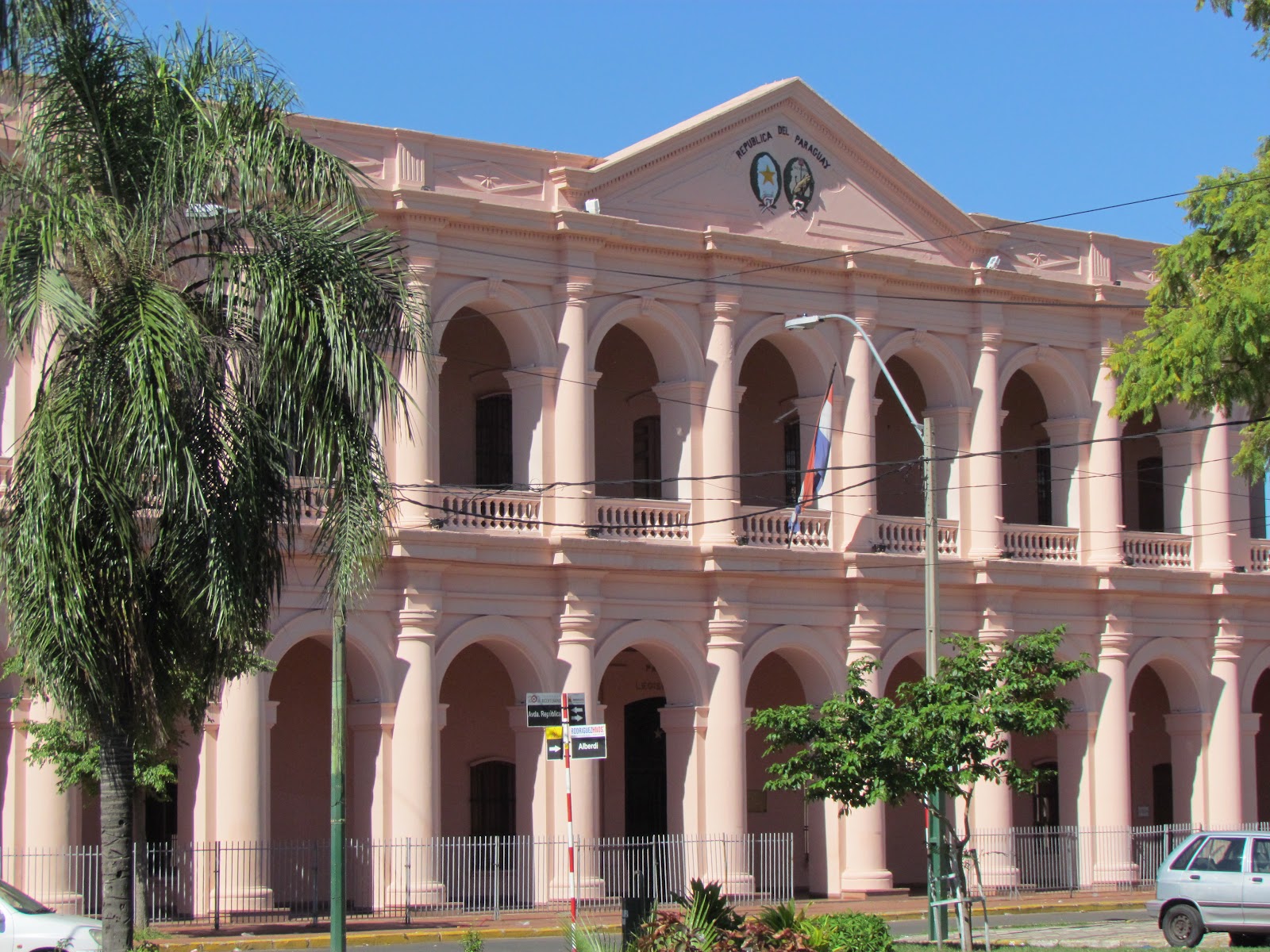
Our next stop was Asuncion, the capital city, and it was on this trip that we noticed the significant change in bus quality - broken seats, no air-con and no toilet.  But it was also a lot cheaper.  We only stayed 2 nights in Asuncion, but met two cool English guys, Harry and Tom, and an American guy, Rob, at the hostel so we inevitably ended up out for a big night on the piss with them straight off.  After about an hour of 'sightseeing' (taking photos of buildings) the next arvo we had a BBQ at the hostel with the guys and checked out the local political rally going on in the street, complete with fireworks.  


We checked out the following morning to go to the bus station as we'd planned on going to a lake a few hours away then on to Concepcion.  We'd then planned on crossing into Bolivia from there.  However, after buying our tickets to the lake and asking a few questions, we discovered it wasn't possible to get a bus from Concepcion to Bolivia - we'd have to backtrack hours and hours to Asuncion and go from there.  So, after some consideration we decided to cancel our tickets to the lake and go straight to Bolivia that night.  It's great having the luxury to change plans spontaneously, but a shame we didn't get to see more of Paraguay.  We had the whole day to kill so we headed back to the hostel to chill out.  We also visited our first museum of the trip - the Police Museum - and it was unlike any other museum.  There were only 3 rooms - one with ancient computers, fax machines and telephone switchboards; one with photos of dead officers and various uniforms; and the final room contained a more eclectic variety of artefacts - taxidermied police dogs, guns and other weapons, drugs and their effects, photos of dead bodies at crime scenes, a dummy display of someone who'd shot themself...but the most disturbing item was an aborted baby foetus in a jar.  No shit.  And we got to see all of this for free.  


Apologies for the disturbing nature of this photo


So despite spending a LOT less time in Paraguay than we'd anticipated, it was a good few days and we met some good people along the way.

Sunday, 13 May 2012

Impressive Iguazu

Iguazu Falls is one of those places in the world that you can never accurately describe to people.  Even photos don't fully do it justice.  Basically, you have to see it for yourself.

We started off on the Brazilian side, where the falls are about 20kms out of the town of Foz do Iguacu.   After a very touristy double decker bus ride and a short walk down a tree-lined path, we got our first glimpse of the falls.  Niether of us wanted to say so, but we were rather underwhelmed and felt guilty for not being more impressed.  But to be fair, there are over 200 separate falls of varying sizes that make up Iguazu Falls, and it just so happened we saw a bunch of the smaller ones first.  They were still very pretty, but the best part came about 10mins later.

Our first glimpse of the falls


The Devil's Throat is the main attraction of the entire falls (for good reason) and you get very different views of it from the Brazilian and Argentinian sides.  Some prefer one over the other, but if you go that far you'd be stupid not to go to both sides.  From the Brazilian side you walk along a walkway that's only about 10m from another impressive fall and inevitably, you get wet from the spray.  Not surprising considering the sheer volume and power of water crashing down only metres away.  Despite not being the 'star' of the show, this fall was pretty spectacular and the rainbows in the spray all around were beautiful.  


At the end of the walkway you can see the Devil's Throat about 50m away, and you get an idea of the amount of water surging over by the clouds of spray filling the valley below.  Now that's what we were expecting.  After 2 or 3 hours we'd seen all the falls on the Brazilian side so we left, looking forward to what the Argentinian side had to offer.

The Devil's Throat as seen from the Brazilian side
Puerto Iguazu is the town on the Argentinian side from which the falls are about 15km.  However, the National Park is so much bigger and has a lot more to see than the Brazilian side, that most people spend 2 days checking everything out.  The fact that you get half price entry on the second day makes this more attractive.  It would be possible to see everything in one day, but it would be a very long, full-on day with no time to chill out or leisurely stroll around.

Our first stop on day one was to head straight to the Devil's Throat and see how different the view was.  It was about 1km on walkways over the water and we saw some huge catfish and even a turtle sunning itself on a rock.  


As we approached the falls we could hear the roar and see the top of it where it all rushes over the edge.  The viewing platform gives an amazing close-up view from the top, so you can see the change of calmly flowing water in the river to the raging cascading falls that is the Devil's Throat.  The water falls from a height of 82m, so the bottom was obscured by a wall of spray. 

The Devil's Throat from the Argentinian side


Everyone was obviously getting photos of themselves with the falls in the background, and Kurt offered to play photographer for one couple just so he could travel back in time and use an old-school wind-on film camera again.  Who knew people still used them?  For the rest of day one and all of day two we walked along the myriad of trails giving different views of all the different falls, and took a boat across to a small island where we spotted armadillos and some big ugly birds.  We also walked to a tiny little isolated waterfall where we braved the cold water and stood under the waterfall.  While it was only small it still hammered down on us and was freezing.  


It was a tiring but rewarding few days, and we saw some of the world's most spectacular waterfalls.  Hopefully some of these photos give you an idea of the beauty of Iguazu.