Wednesday, 15 August 2012

The Galapagos Islands - it doesn't get much better

The Galapagos Islands were another dream destination on our list, and a once in a lifetime trip.  We were expecting it to be expensive and had figured it would cost around $5,000 in total for about 5 or 6 days, so we were prepared to fork out a lot of cash to see this amazing place.

The Galapagos Islands are an archipelago of volcanic islands around the equator, over 900km west of Ecuador (which they are a part of).  There are 14 main islands and 3 smaller islands, as well as over a hundred rocks and islets.  However, for the sake of tourism there are 3 main islands that people visit or stay on - San Cristobal, Santa Cruz and Isabela.  It's possible to visit some of the other smaller islands on cruises etc, but boats are prohibited to enter some areas of the Galapagos.  This is a good thing as it helps to protect the more than 7,000 identified species in the Islands.  So as you can imagine, it was almost impossible to turn a corner without seeing something new and different, and amazingly cool.

When we arrived in Quito we went to a few agencies to get an idea of the cruises they offered, prices and possible dates to leave.  The average price of a 4 day boat cruise (mid-level in terms of quality) was about $1,200 dollars per person, not including flights and the entry fee to the Islands.  So all up it was looking like it would cost around the two grand mark each.  About what we were expecting.  However, we hate organised tours because you never know what you're going to get in terms of quality, and there's nothing worse than being stuck on a boat with a bunch of people you can't stand.  We also hate being told what to do and when to do it - that's not our idea of fun.  For this reason we were very unsure about what to do, as we wanted to have the best experience possible.  Obviously.  And it's not like you can just pop back over again if it doesn't work out how you want it.  So, after briefly talking to a guy at our hostel who had recently volunteered on the Islands and highly recommended we just do the whole trip ourselves, our minds were made up.  We didn't really need much convincing.

We hadn't really thought it would be possible to visit the Islands independently and still see and do everything we wanted, so to hear that it was not only possible but recommended by many people, we were stoked.  After deciding which islands we wanted to go to and how long for, we booked our flights directly from the airline.  It couldn't have been easier, and cost us $934 for return flights for both of us to the airport on Baltra Island, which is above Santa Cruz Island.  At Quito airport we had to pay $10 each for a 'visa' for the Galapagos, then upon arrival in Galapagos there's a $100 park entrance fee per person. The flight was about 2.5 hours, then we had to get a bus to a small channel to get a boat across to Santa Cruz Island.  Then it was a 45min bus ride to Puerto Ayora which is the main town on the island and is the most populated town in the archipelago.  We were totally surprised at how many people actually live in the Galapagos - somewhere between 19,000 and 25,000, depending on where you get your information from.  Luckily there weren't many tourists staying on the islands when were were there, otherwise it would have felt way too crowded. 

We spent 3 nights on Santa Cruz, and while it was more expensive than what we're used to, it wasn't ridiculously over-priced.  We paid $30 a night for our room, but that included a really good breakfast.  And because we're not ignorant tourists, we ate where the locals ate which saved us a LOT of money.  We could get a set menu lunch for $2.50 which included soup, a main and a glass of juice.  Who knew that would be possible in an isolated place 900kms from the mainland?  And for dinner the most we paid was $8 each, but that was for prawns in coconut sauce and rice.  Bloody delicious. 

There was actually quite a lot to see and do on Santa Cruz, so we had no problems filling in our time there.  We visited a tortoise breeding centre where we could see tiny little babies up to ridiculously huge adults which would have been at least 100kg.  There were also iguanas there, but yellow ones which I'd never seen before.  


One day we hired bikes and rode more than 7kms out of town, pretty much all uphill, to a lava tunnel known as the 'Tunnel of Love' because of the heart-shaped hole in the ceiling of the tunnel. It was a scenic ride, but who wants to ride over 7kms uphill on a scorching hot day?  Needless to say, the return journey was a lot easier, but we were feeling the pain quite intensely for a day or two.  

The heart shaped hole


One of the most beautiful and unique places we visited on Santa Cruz was called Las Grietas, which is two giant walls formed by volcanic rock with crystal clear blue-green water in between.  It's a popular spot for snorkelling, however there wasn't much to see when we were there.  It was still an amazing place to be though.  And Kurt couldn't resist climbing up then jumping off the rocks from about 10 metres, but the hard landing was a bit painful on the old kidneys.  It looked impressive though.  

Las Grietas


That same day we walked out to Tortuga Bay, which is a stunning beach with the softest, finest white sand we've ever walked on.  It continued all the way into the crystal clear water too, not a single shell or sharp object in sight.  It was gorgeous.  

Tortuga Bay


We also did a half day tour of the bays, but it was a bit disappointing.  The only reason we did it was to visit a small islet where you can swim and snorkel with sea lions anytime of the year.  But when we got out there we hung around for a few photos then the boat just took off again.  Apparently the current was too strong so we weren't allowed in the water.  We were both so pissed off because that was the whole point of the tour for us.   We then got off the boat and walked around to a beach where there were shitloads of marine iguanas crawling all over the place and each other.  It was pretty cool because it took a while to spot them as they blended into the dark rocks, but once we saw them they were everywhere.  After that we had time for some snorkelling, spotting heaps of cool fish, including huge schools of them that would cruise by.  I was just hoping a shark wouldn't come along for a feed and get us as well.  Me, paranoid?  Perish the thought.


After 3 nights on Santa Cruz we got the ferry over to Isabela Island.  Now, I don't know what everyone's idea of a ferry is, but to us it's a large boat that holds about 100 people or more and moves pretty slowly.  That is not what we got on.  Not even close.  It was a speedboat that held about 20 people, with three 300 horsepower engines.  So instead of a nice leisurely cruise across to Isabela, we hammered across the water at ridiculous speeds, regardless of how choppy the waves were.  We were sitting up the front so were getting absolutely smashed everytime we slammed into a wave, so much so that Kurt had to stand up for the last half hour or so to ease the pain on his back and tailbone.  Under those circumstances I was very surprised I didn't get seasick, but others weren't so lucky.  One poor woman across from us was spewing into plastic bags and looking very pale and sweaty.  Not a fun way to spend 2 hours.  It was one of those situations where you secretly think, rather you than me.

Isabela is the largest island of the Galapagos and is shaped like a seahorse, formed by six volcanoes merging into a single land mass.  Five out of the six volcanoes are still active, making it one of the most volcanically active places on earth.  While this island is bigger than Santa Cruz, the main town of Puerto Villamil is much smaller than Puerto Ayora.  As a result there's not as much choice in terms of food.  We paid $25 for our room (with air-con this time) but it didn't include breakfast, so it ended up about the same price as on Santa Cruz.  We stayed for 4 nights on Isabela and it was awesome.  We explored the island a bit, hiring bikes again (gluttons for punishment) to ride out to an area where there are a few things to see.  However, after about 30mins Kurt got a puncture so we stashed our bikes in the bushes  and walked the rest of the way up to the Wall of Tears.  On the way up we saw a pretty big land turtle on the side of the road, which freaked the fuck out of me when it kind of hissed at me as we walked past.  It was cool to see one in the wild though, and we might not have spotted it if we'd still been on the bikes.  


We finally arrived at the Wall of Tears which is so named because it was built by prisoners when there was a Penal Colony on the island from 1946 to 1959.  As punishment the prisoners were forced to build this wall with huge blocks of lava, and it measures about 100m long by 7m high.  You can climb up to the top of the wall which has a spectacular panoramic view of the place. 


On the way back down we checked out a little cove that was beautiful and had a marine iguana just chilling in the incoming tide, and back down at the bottom we had a quick look at a tunnel that was formed by volcanic eruptions and leads under the sea.  


Then Kurt spotted a tourist truck which had a space on the back where a bike would fit.  So I went and asked if he could take me and Kurt's bike back to town while Kurt rode my bike back.  Thankfully the guy was nice enough to agree, so one of us didn't have to make the long walk back.  We went straight to get the tyre fixed so we could explore another area of the island.  We'd read about a little bay down by the port which was supposed to be good for snorkelling, so we headed out there.  But on the wooden walkway out there we came across a blockade - a cute little sealion just hanging out.  


It had big gorgeous eyes and didn't seem too phased by our presence, so we took a few photos before quietly sneaking past.  At the jetty there were a couple more sealions, much larger, sleeping on the warm wooden boards under the shade.  Again, they weren't bothered by us being around them, but we didn't want to get too close.  So we kitted up with snorkels and fins and jumped into the water.  We saw heaps of cool fish and almost immediately a couple of sealions came to check us out.  They were swimming with us and around us pretty much the whole time we were snorkelling, and they'd come so close we could have touched them.  It was such a cool experience to see them playing around, moving through the water so quickly and gracefully right in front of and under us.  They really are curious and beautiful creatures.  It was one of the things we both really wanted to do during our time in the Galapagos, and it was one of the highlights.

Our private snorkelling spot


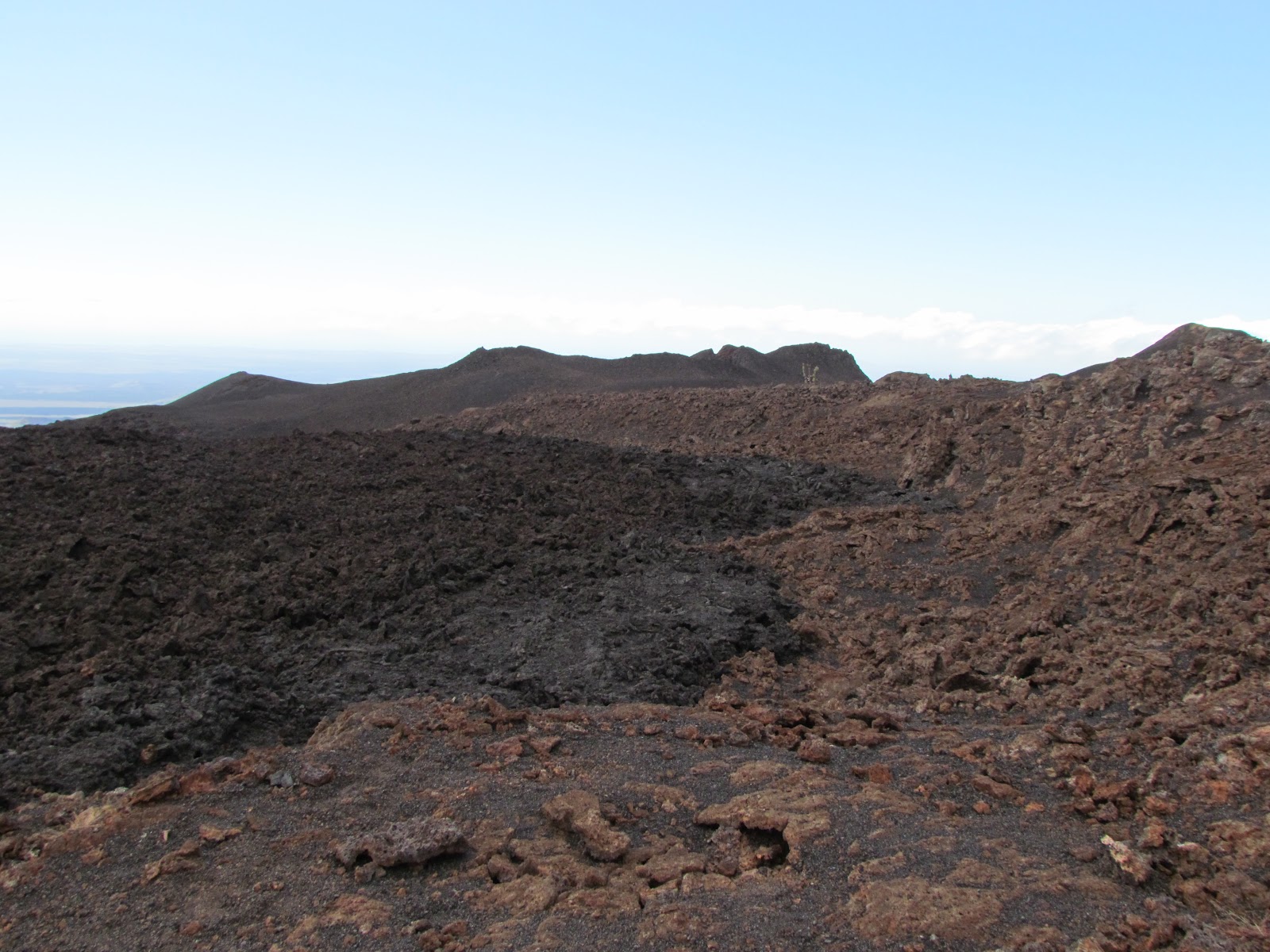
Because Isabela has so many volcanoes, we couldn't leave without climbing at least one.  Most of the volcanoes are located in the National Park and can't be visited without a guide, so we had to do a tour.  We visited Volcan Sierra Negra and Volcan Chico, which was about a 5 hour round trip walking over varied landscapes.  We arrived at Sierra Negra first, which is an active volcano, last erupting in 2005.  It's also the second largest caldera in the world at 70 square kilometres.  However, because it was still quite early the view of the caldera was completely obliterated by fog/clouds.  Our guide assured us that we'd be able to see it on our return back down, so we continued on to Volcan Chico, which is a collection of smaller cones on the slopes of Sierra Negra.  There was a pretty dramatic change in landscape at this point as we left any form of vegetation behind and clambered over black boulders and rocks, which came up against a solidified ocean of lava. 


Solidified lava

Some of these rocks were so sharp and brittle like glass, so we had to walk carefully.  The landscape was unlike anything we've ever seen, it was like being on another planet.  We walked up to the top of one cone which had a breathtaking view out over the island to the water.  

Volcan Chico


Like I said, we were constantly amazed by the things we saw every single day.  On our way back we came across the lookout point for Sierra Negra and, sure enough, it was clear enough to see the enormity of it.  It was a massive black crater, with fissures and cracks all over it, some so big they looked like roads.  To know it's still active is quite scary, as there's not really anywhere the locals can evacuate to if there's another eruption.

Volcan Sierra Negra


Because the volcano tour was so good we decided to do another tour with the same company, but just a short 2.5 hour one this time.  We went out in a boat to a snorkelling spot, where we saw plenty of fish again, a small ray and another big fuck-off ray.  We weren't expecting to see that so it was an awesome surprise.  There was also a group of sealions there, so they were swimming and playing around us again.  It hadn't lost its magic the second time around.  

Small ray


Electric blue fish

Massive ray


After that we visited an islet called Las Tintoreras, which is a lava canal where white fin sharks (called tintoreras) often rest.  Unfortunately we could only spot the shadow of one shark sleeping at the bottom.  But there were plenty of other things to see, as on the islet there were also heaps of birds, marine iguanas and sealions.  We also spotted our first sea tortoise out in the bay, which was one thing we sadly didn't get to see whilst snorkelling.  On the way back to shore we went past an outcrop of rocks with a bunch of penguins and blue-footed boobies.  Not a bad way to end the day.

Blue-footed boobie


After 4 nights on Isabela we had to get the early 'ferry' back to Santa Cruz to catch our flight.  Fortunately we'd learnt from the hellish ride over, so we made sure we were first on the boat to get the prime seats at the back of the boat, in front of the motors.  Although it was uncovered and we got rained on for a while, it was a million times better as the ride was much smoother.  It was so much more enjoyable when we weren't getting slammed around every time we went over a wave.  This time we got to watch the people sitting inside wincing with pain and discomfort instead. 

As with nearly all trips, however long you have is never enough, and this was the case with our time on the Galapagos Islands.  We could easily have spent weeks there seeing and doing new things every day, but it was just too expensive.  But, because we did it ourselves it cost only a fraction of doing a cruise.  In total, we spent just under $2,000 for the two of us for a week, and that included everything - flights, visas, entrance fees and everything we spent on the islands.  And we got to do everything our way which made it so much better for us.  The Galapagos lived up to our expectations 100%, and we left totally blown away by what we'd seen and done.  It truly is a magical place on earth.

Thursday, 9 August 2012

Mellowed out in Mancora

After getting back from the Amazon and spending a few more days in Lima, we were hanging out for some quality chill out time on a beautiful beach.  We hadn't done that since we were in Brazil in February, so it was well over-due.  Our timing worked out well again so we planned to meet up with Derek and Kelly in Mancora.

Mancora is a  beach town right up in the northwest of Peru, not far from the Ecuadorian border.  The Pan-American Highway runs right through it (it's actually the main street in Mancora) so it's easy to get there from anywhere else in the country, or from Ecuador.  It's a very popular tourist spot, but also for locals, especially surfers.  As you would expect in any beach town, there are so many resorts and different price levels of accommodation to choose from, including a couple of notorious party hostels.  We wanted to completely avoid that scene though and just chill out, so Derek and Kelly, who had arrived a few days before us, scouted things out and found a perfect spot.  It was about a 20-30min tuk-tuk ride out of the main part of town, away from the noise and hustle and bustle of the main road and party hostels.  There were still cabanas and places to stay out there, but it was nice and quiet.  The place they found for us had two bedrooms, both with ensuites and open-air showers, and a massive open living area in the middle with kitchen and a huge 50 inch TV with digital channels.  Absolutely perfect, we couldn't have asked for a better place.  


We celebrated our reunion and our first night in our new holiday home with a home-cooked meal and plenty of beers.  And that was pretty much how we spent the next week.  We initially confirmed for 4 nights, then Derek and Kelly decided they'd stay for another couple of nights and we definitely weren't going anywhere, so we stayed put. 

The beach was only a 30 second walk from our place and it was absolutely stunning.  Miles and miles of golden sand and hardly a person on it.  I don't know how busy the main beach was in town, but we loved having almost the whole beach to ourselves.  The weather was pretty much perfect the entire time too - sunny and hot (but not too hot), in the high 20's during the day, and about 20 degrees at night.  The only annoying thing was the bloody mosquitos!


We had a few regular visitors to our place while we were there, in the form of a group of local dogs.  There were about 5 of them that would wander through our living room and either lounge around for a while or just pass through.  One dog in particular stood out from the rest as he was very unique.  He was a Peruvian hairless dog that we named Santa's Little Devil, and he was a freaky thing.  He was very friendly and liked attention, but it was the weirdest experience to pat him.  His hairless skin felt so strange to touch, it was kind of gross at first, but he'd always come back for more.   Derek was tempted to take him home, but realised the logistics, among other things, may pose a problem.  I hope some other tourists have befriended him now.

Santa's Little Devil

Our week in Mancora was exactly what we had been looking forward to - chilling out on the beach, swimming, reading, watching sports, cooking awesome food and drinking a lot with good friends.  Thanks again Derek and Kelly for finding that place, it totally made our stay in Mancora.  And I guess you guys had a little bit to do with that too :-)

Tuesday, 7 August 2012

The Amazon - all kinds of awesome

The Amazon River and Amazon rainforest are another couple of places you grow up hearing about but never think you'll find yourself there.  For Kurt especially it was a lifelong dream to go to one of the most naturally diverse and mindblowing places on earth.  Now we just had to decide where we'd do it.

The Amazon River itself is the second longest river in the world and flows west to east from Iquitos, Peru, all the way across Brazil to the Atlantic Ocean.  It flows mostly through these two countries, but it is part of the border between Colombia and Peru, and it has over 1,100 tributaries reaching into Venezuela, Colombia, Ecuador, and Bolivia.  And then there's the Amazon rainforest, which is the largest in the world, covering well over 8 million square kilometres.  It's almost impossible to comprehend just how huge that is.  However, with all the deforestation that's gone on over the years and continues to happen, who knows what will become of it?  If only those ignorant, selfish bastards would think of the consequences.  Obviously that's far too much to ask for.

When we were in Bolivia we considered going to a place called Rurrenabaque in the north, as a lot of tourists do jungle/pampas tours from there.  However, the Amazon River doesn't actually flow through Bolivia which kind of defeated the purpose of doing an Amazon tour there, so we crossed that off the list.  It was when we arrived in Peru that we decided the best place to do a tour would be from Iquitos, in the northeast of the country.

Iquitos is actually located on the Amazon River itself, and the only way to reach the city is by plane or boat, with the exception of a road to Nauta, a small town roughly 100km south. It's the largest city in the world which cannot be reached by road.  Pretty cool, ay?  So, we booked our first flights in 6.5 months and thankfully it wasn't too expensive - just under $300 return for both of us.  When we got there we were surprised by how big a city it actually was and that there were pretty much no cars whatsoever - only motorbikes, buses and about a million mototaxis/tuk tuks.  It was crazy.  The central part of town where we stayed was a bit run down and shitty, but what can you expect from an isolated city in the Amazon? It was also bloody hot, which was a nice change from the pretty much constant cold weather we'd had for the last month or two.  Time to bust out our now pasty white limbs.


We arrived in Iquitos early on a Sunday morning, so that afternoon we walked around a few tour agencies to find out prices and details of tours offered.  We've found that you get the best deals by booking closer to the time rather than booking online in advance, as you get it much cheaper.  We found one agency that had good reviews online, but being a Sunday it was closed.  Never fear, the security guard sitting outside called the owner who showed up about 15 minutes later in the car with his whole family, half drunk.  Awesome.  He was still able to give us all the information we needed though, and in the end we decided it was the best we'd found.  We initially thought we'd do a 3 or 4 day tour, but ended up going for the 5 day option which left the next morning.  And the best part was that there was only one other couple booked on the tour, meaning there would only be 4 of us.  Actually no, the best part was that we ended up paying about half the price they did.  Yeow! 

On Monday morning we were picked up from our hotel at about 9am and then we had to go pick the American couple up from the airport as they were only just flying in that morning.  It was absolutely pissing down which was a nice welcome for them.  Not.  Jennifer and Bill were from a small town in Oregon, and we had a couple of hours to chat a bit on the drive to Nauta, the small town where we got on our first boat which would take us to the village we'd be staying in.  The boat was fairly comfortable with seats and a 'roof' which we were thankful for shortly after when it started pissing down again.  We passed several other small boats with locals that were almost sinking in the river, and they were all huddled together getting pelted by the rain.  Poor bastards. 

Our boat

Their boat

We were on the boat for about 2 hours on one of the tributaries before we got to the mouth of the Amazon River.  And, pardon my French, but fuck me it's a massive river.  It varies between 1.6 and 10km wide at it's lowest stage, but during the wet season it expands to 48km or more.  We were there about a week after a massive flooding, so we could see the watermark on the trees at least a metre above the current level.  It was even more apparent when we reached the tiny village we stayed in.  The houses are all built on stilts, and when we arrived the first day the watermark was above the floor level.  We were actually supposed to have stayed in a lodge the agency has for tours, but it had been flooded and couldn't be used.  So the four of us stayed in one house which was basic, but we had a bed and mosquito net each and a toilet, and a roof over our heads.  No need for much more.  Well, a shower would have been a bonus, but when you're all in the same boat (literally) and wear the same clothes for five days getting steadily stinkier, it's all even stevens.

Watermark on the house from the flooding

Our humble abode

Over the next 5 days we ususally spent a few hours each day on a little canoe that was very authentic and obviously hand made by the villagers, but was incredibly, bum-numbingly uncomfortable.  But when you see so many different kinds of new and amazing creatures every single day, you can forget the numbness for a while.  I can't even list all the different things we saw, but there were about a hundred new bird species, butterflies, bugs, monkeys, a sloth, iguanas, fish (including piranhas), caimans, both grey and pink dolphins, giant water lilies and just simply stunning scenery.  We really wanted to see the famous pink dolphins, and we weren't disappointed.  Once we started spotting them they were all over the place, and surprisingly unattractive.  Well, strange looking from what we could see.  They were a very pale pinky grey colour and had a weird looking humpy back and head.  Not as beautiful as the other more 'normal' grey dolphins, but it was amazing to see such a rare creature.  Quite a buzz really.  Basically the only thing we didn't see at all was an anaconda, but our guide told us that he's lived in the jungle all his life and he's only ever seen two in his lifetime.

A big bird

Spider monkey

Sloth

Iguana
Pink Amazon dolphin


Giant water lilies


Bill had brought his own fishing pole with him, so one day we found a good place and he tried his hand at a spot of fishing.  There was clearly shitloads of fish around, as we'd see a whole heap of little ones suddenly leap out of the water, maybe getting away from bigger ones.  Whatever the reason, it was an awesome sight, and it happened over and over.  It took a while to get his first one, but Bill then caught four fish in quick succession.  And two of them were piranhas.  They're pretty innocuous looking little things until you see the teeth, and they are razor sharp.  So thanks to Bill, dinner that night was a feast of fish, and they were all actually quite tasty.  Not too many people can say they've eaten piranha.  At least it wasn't the other way around.

Piranha!

 
Our English speaking guide, Homer, was only about 24 and had grown up in a village further north on the river, so he knew a lot about the local wildlife.  He could name all the different birds at a glance which was pretty impressive and could spot things miles away.  But even more impressive was our other local guide, Miguel, who was older and therefore had a lot more experience and basically did all the cool shit.  He was pretty much a combination of MacGyver and Bear Grylls and was totally awesome.  When we camped out for two nights deep in the jungle he constructed the shelter for our tents, made fire and cooked for us, bushwacked a trail on a 6 hour walk through the jungle and didn't get lost (well, actually that's debatable), demonstrated how they weave thatched roofs, hacked open tree trunks to look for huhu/witchety type grubs, identified trees that when cut open had a sweet milky substance you could drink and other roots/plants that when cut open held water for drinking, and that by rubbing termites all over yourself you have a natural bug repellant because of the smell it gives off.  We were a bit wary of this one, thinking he was just taking the piss and wanted us to get termites all over us, but we tried it anyway.  Any kind of repellant to keep the mozzies away is a blessing. Just being around someone like him and witnessing how much he knew was incredible.  And I don't know about the others, but it definitely made me feel a whole lot safer knowing he was with us.  Especially when we went caiman hunting one night. 

The start of our tent shelter

Termites ready to be squished into repellant


Miguel weaving a thatched roof

Drinking water from a plant
We set off from the village on our last night at sunset and headed to a spot where they know caimans hang around.  Then we had to sit and wait quietly for about an hour until it got fully dark, which was a bit unnerving.  Then we circled around a pretty large area, with both Homer and Miguel calling to the caimans to try and locate them, and using a headlamp occasionally to find our way and try and see the tell-tale shiny reflection of the light in their eyes.  Miguel got excited a couple of times when he thought he could hear a big one, but we couldn't find it.  Probably a good thing, because if we'd come across a 2 or 3m caiman in our dodgy wooden canoe that was only just above water level, I would have freaked the fuck out.  As it was, we spent at least an hour circling around and had almost given up when all of a sudden Miguel spotted one, clambered over from the back of the canoe to plunge his hand in the water and came up with a caiman in his hand.  I had no idea what to expect, but it was just a little baby one, about 30 or 40cm long.  It was actually really cute and not at all scary.  Well, I still didn't want to put my fingers anywhere near it's mouth, but it wasn't going to kill me.  I just hoped mummy wouldn't hear it's scared little cries and come over to fuck us all up.  We all got to hold the baby caiman and get photos, but Kurt had to remind me to release my death grip on it before I choked the poor thing. Sorry little buddy.


A bigger caiman the villagers caught

So, after 5 incredible days on the Amazon and in the jungle, we headed back to Iquitos for one more night (and a much needed shower) before flying back to Lima.  That final afternoon in Iquitos Homer and Miguel took Kurt and the others to the Belen market (I opted to stay in the hotel and chill out).  Kurt said it was a pretty dodgy experience which could have turned ugly real quick if they hadn't turned back at one point.  The market is full of black market stuff where the locals illegaly trade in protected rainforest animals and wildlife.  There were dead animals, skins and skulls and all sorts of other crazy shit.  They didn't stay long because it started to feel a bit ominous, so they wisely got the hell out of there.


I know I've said it about a lot of other things we've done so far on our trip, but our time in the Amazon was yet another highlight and completely unforgettable.    

Sunday, 5 August 2012

The lowdown on Lima

Our next stop after Cusco was the capital city of Peru - Lima.  Despite being a 21 hour overnight bus ride from Cusco, it was surprisingly one of the best and newest buses we've been on.  It was also the first time wifi was available onboard, however for some reason we couldn't connect on our laptop, only those with phones could.  We could, however, charge up the laptop so we could watch hours worth of movies to pass the time.

Lima is on the coast, pretty much halfway down (or up) the country.  It's the biggest city in Peru and is massively spread out.  We'd decided to stay in an area called Miraflores, which is popular with tourists because of all the bars, restaurants and shops, and it's a nice clean area with parks and is also close to the beach.  Not that the beach is anything to write home about.  It's actually pretty crap to be honest.  But it was nice to be on the coast again, even if we couldn't actually enjoy the beach.  The other unfortunate thing about Lima was the weather.  It was usually pretty warm so that wasn't the problem, but 99% of the time it was dull grey skies.  Not as depressingly grey as London, but even London gets brilliant sunny days a few times a year.


During the few days we were there we managed to catch up with Jose, a mate of Kurt's he worked with back in Sydney who was born and bred in Lima.  He took us through the historic central district of the city where there is loads of colonial architecture (and for some strange reason nearly all the buildings around one plaza are yellow), churches and the Monastery of San Francisco which we visited, including the catacombs that connect it to a cathedral.  It was pretty trippy being underground and seeing all the bones categorised into types, and knowing how many thousands of people were buried there.  We also wandered through Chinatown and Jose pointed out the best restaurant so we could go back there for my birthday the following week.  It was hard to resist the call of delicious dumplings there and then though.


Once again we crossed paths with Derek and Kelly, so had our customary night out together drinking many beers and talking shit.  Quite frankly it's impossible not to have a big night out when the beers are so cheap.  It makes you wonder why the hell we pay $7 or more for a beer in a pub at home when we were getting 2 litres for $8.  I know which one we prefer. 

When we got back to Lima after the jungle we celebrated my 30th birthday with an awesome lunch in Chinatown (get in my belly you delicious dumplings!) then many beers.  It was a Monday night so there wasn't much happening, but we managed to find some people to drink with at a hostel nearby.  The hangover the next day wasn't as bad as I feared, however I certainly knew I wasn't 21 anymore.  


We didn't really explore too much in Lima, but we liked the city.  It had a good feel to it and seemed liked a decent place to live, but it could do with better weather and beaches.  But we left having seen some cool stuff and eaten some great food, and caught up with good friends.  Can't really ask for much more than that.