Sunday, 9 September 2012

Quality time in Quito

When we first arrived in Ecuador we headed straight up to Quito which is high in the Andes (2850m) in the north of the country.  And even though it's the capital, it's the second largest city in Ecuador with a population of about 2.5 million.  The city is ridiculously long and spread out, so it takes an hour to get from either the north or south bus station to the city centre.  But public transport is really good and crazy cheap (only 25 cents no matter how far you go), so as long as it's not rush hour it's all good.

There are two main areas in Quito that are worth seeing - the Old Town and the New Town.  Pretty self-explanatory.  In the New Town there is an area called the Mariscal where the majority of travellers stay, as it's got shitloads of hostels, hotels, bars and restaurants.  In our first week there we ended up staying at 3 different hostels in a row on one street.  Just spreading the love around.  Our favourite hostel was the last one we stayed in, called Galapagos Natural Life Hostel.  It was quite a small place that would have accommodated about 20-25 people, and it was great.  For $8 a night we had a comfy bed in a dorm (only 4 beds and they weren't bunks) and one of the best breakfasts we've had so far - fresh fruit and yoghurt, scrambled eggs with fresh bread and home-made butter, fresh fruit juice and hot chocolate.  And the owners were an old couple that were just like everyone's grandparents and made the hostel feel like home.  So, if you're ever in Quito, we definitely recommend it.

In our first week, before we went to the Galapagos Islands, we did a couple of touristy things.  There's actually not a huge amount of things to see and do in Quito which we actually liked, as we didn't feel obliged to go out and do something every day.  Sometimes we just want to chill out and do nothing.  But we did go and wander around the Old Town, which has some beautiful old churches, cathedrals, convents and monasteries, as well as the Presidential Palace which is on the central plaza.  The changing of the guard takes place there every Monday at 11am, but unfortunately we didn't manage to get back for that.

Presidential Palace

The Church with the golden door.

The Monastery of San Francisco


It was a nice area to walk around for a while, then we got a taxi up to El Panecillo (Little Bread Loaf hill) where there's a huge statue of the Virgin of Quito.  The view from the top is amazing, as you can see the whole city stretched out below and also the surrounding volcanoes.

The statue of the Virgin of Quito.


Ecuador's biggest claim to fame is the fact that it's located on the equator.  About 22km north of Quito is the Mitad del Mundo (Middle of the World), where there's a huge monument marking latitude 0o0'0" on the equator.  However, because these measurements were first made in 1736 there was no such thing as GPS, therefore the monument, built between 1979-1982, is actually in the wrong place.  How embarrassing.  Even more embarrassing is the fact that so many tourists go there and get all these photos hopping over from one side of the 'equator' to the other, not knowing that they're in the wrong place.  We'd read about this before we went so we knew, but we wanted to go anyway.  It was funny to watch people blissfully unaware of their ignorance. 


Yes, we know it's in the wrong place, but we'll get a photo anyway just so no-one suspects we know.

 About 200m north of the Mitad del Mundo is a museum called Museo Solar Intiñan, which is located on the true equatorial line and also lies on a 1000 year old indigenous site.  Funny how the indigenous knew where the equator line was 1000 years ago, and French scientists couldn't figure it out just over 250 years ago.  This museum was a million times better than the monument as it had explanations of the lifestyle of the indigenous tribe that lived there, including how they shrunk heads (we saw one of the few real ones but weren't allowed to take photos). 

The REAL equator line at Museo Solar Intiñan.

Step 2 of the head shrinking process - remove skull.
 
Step 5 - insert hot rocks into empty 'head'.

Burial chamber of a Chief.


There were also some cool 'scientific' experiments you can do, like watching water go down a plughole in different directions depending which side of the equator it's on.  And it really did change directions when it was moved from the 'northern' hemisphere to the 'southern' hemisphere, and it went straight down when it was on the equator line.  Crazy.  There was also an experiment where we had to try and balance a raw egg (on it's fatter end) on the flat end of a nail.  Whoever could do it got a certificate at the end, proving they were an 'Egg Master'.  Of course both Kurt and I proved our skills at mastering the egg.  Was there really ever any doubt? Then there were a couple of experiments to do with energy and balance.  One was trying to walk along the equator line with eyes closed and arms held out to the sides.  Every adult who tried it fell over almost immediately, but kids, who have a lower centre of gravity, could walk along easily.  And we also tested out strength, which is almost non-existent when standing directly on the equator line.  The place was touristy, but really fun and interesting.  And it's actually the proper, GPS calculated location of latitude 0o0'0" on the equator.  If only everyone knew it.


Quito, and in particular the Mariscal, is a big party town.  Across the road from our hostel was an Irish bar where we became regulars during our time in Quito, drinking the very average local Ecuadorian beer (Pilsener) and meeting heaps of other travellers and ex-pats living in Quito.  Two of the bar owners were actually Irish, so we got to watch a few Wallabies and All Blacks games in the wee small hours.  We also ate some great food, as there was an amazing variety of restaurants in the Mariscal that we'd been missing for months.  We ate Mexican, Indian, Thai, Chinese and Uruguayan steak.  We did also eat local food at a big market, mainly at lunchtime when we could get a set lunch for $1.50 - soup, main course of either meat/chicken/fish with rice and beans or salad, and a glass of juice.  We'd just wander around the market until we found a little stall with a menu we liked the look of then pulled up a stool. We have no idea how it's even possible to get so much food for so little, but our stomachs and wallet were happy.

The market where we ate our cheap, tasty lunches.

When we got back from the Galapagos we spent 4 more nights in Quito at the same hostel, and we were welcomed back with open arms by our 'grandparents'.  We didn't really do anything except drink and chill out before we went south to Baños and then to the coast, then we were back in Quito yet again.  We'd decided to do Spanish classes for a month as it seemed to be the cheapest place to do it, and we also really liked the city and were happy to settle in somewhere for 4 weeks or so.  We stayed another week at the hostel before someone recommended a cheap hostel up on the hill that rented out rooms long-term.  We only had to pay $225 for our own room for a whole month.  That worked out at $7.26 a night for both of us.  Can't get much cheaper than that.  And even though it was a struggle to walk up the hill every time we went out, it was worth it for the incredible view from the roof-top terrace. 


We were also finally able to cook for ourselves again, as there hadn't been a kitchen in any hostels for months.  So for a month we got into a routine of going to classes in the morning from 9am-12pm, then getting a cheap lunch at the market and doing homework and chilling out in the afternoons.  Our classes were also pretty cheap - $9 an hour for the two of us with our own teacher.  She was good and went over stuff we'd learned in Sydney, but it was helpful as it made more sense and was easier to remember this time round.  We also learnt some new stuff, and we're now finally able to use the past tense which is useful as we no longer have to sound like retards who constantly talk in the present tense.  But we ended up getting pissed off with the school, as our teacher was a no-show twice without anyone telling us in advance.  If we ever couldn't make it to class we had to give 24 hours notice, but the same rules apparently didn't apply to the staff.  So we decided to just spend the last week revising and studying what we'd learnt by ourselves, rather than get fucked around again. 

The final touristy thing we did in Quito was to go up the Teleferico, which is a gondola-type ride that takes you up the eastern side of Pichincha Volcano to the top of a massive hill lookout (4100m), with spectacular views over the city.  Claire, a German girl we met in the hostel wanted to do it before she left Quito that day, so we went along.  We walked a short way up the hill, but none of us were keen to make the 3.5 hour hike to the summit of another mountain.  We had a good enough view where we were and weren't in the mood for strenuous activity.


Our final month in Quito flew by, and before we knew it we had to leave if we wanted to see another place before our 3 months were up.  We loved Quito and it really became our home in Ecuador.  We learnt some more Spanish, ate great food, drank way too much and met awesome people in this city.  It's probably only the second place we've been so far that we could actually see ourselves living.  We were sad to leave Quito, but also excited as it meant we were on the move again.

Wednesday, 29 August 2012

Cruising the coast of Ecuador

After Baños we were ready for some quality beach time, so we headed out to the coast.  After a 10 hour overnight bus ride from Baños, we arrived in a town called La Libertad.  We then had to get a taxi out to the beachside city of Salinas where we thought we'd start our coastal journey.  However, when we got there it was 6am and no hostels/hotels were open, and the ones we saw looked way out of our price range anyway.  It just seemed like too much of a resort town where rich locals or tourists would go, so we decided to jump on a bus and head further north to Montañita.

Montañita is a small coastal town on the Ruta del Sol (Route of the Sun) and is a tourist mecca for surfing, partying and chilling out on the beach.  We walked around a few hostels and eventually chose one that was right across from the beach.  The only thing separating us from the water was the sea wall, so it was a great view from the balcony.  

View from our hostel


We were only there for 2 nights during the week so we didn't see any of the craziness that we hear happens on the weekends, but the beach was still pretty packed during the day.  It was a really nice beach with soft sand and beautiful warm water, and a shitload of optimistic surfers waiting for a wave.  Apparently it was the wrong time of year for good surf, but that didn't deter people.  And although it's probably the most touristy place on the coast, we still managed to find some good, cheap local places to eat - $1.50 for a 2 course lunch and juice, and $5 for dinner.  It really isn't hard to escape the over-priced tourist restaurants if you try.  So after only a couple of days chilling in Montañita we decided to keep heading north to the next place.


That next stop was a small fishing village called Puerto López, which is one of the main spots to go whale watching between mid-June to October.  That was all we really knew about the place, so we found a hostel and figured we'd find a tour for the next day.  As it turned out, the hostel either owned or worked in conjunction with a tour agency around the block, so we got a discount for the whale watching tour.  It was only $15 each which seemed to be a pretty good deal, so we booked for the second day.  We asked the girl how likely it was that we'd see whales and she assured us it was 100%, but she wouldn't agree to give us our money back if we didn't see any.  What a surprise.  The weather wasn't great and there was a bit of a swell, so when we got to the whale watching 'spot' and turned the engine off, we were rolling around a bit.  There were other boats out there too, just sitting and waiting to spot a whale.  So we sat, and we waited.  And waited.  For about an hour (well, it felt like that long, but was probably much less), until someone yelled out and then we were off on the chase.  It was crazy, every time someone spotted a whale we'd go charging off after it so we could get as close as possible.  At home there would be strict rules about how many hundreds of meters away you had to stay to give the whales space, but no such rules exist in Ecuador.  The first couple of times I only saw the spray of water from the blowhole, but then eventually we kept spotting their backs as they'd breach the surface.  


Of course the one time a whale actually jumped high out of the water we were facing the wrong way and missed it.  Bugger.  It was also impossible to get a good shot when we were rolling around over big waves, but at least we got to see quite a few whales.  Lucky, or that poor girl would have had us demanding our money back.  And Kurt wouldn't have taken no for an answer.  Again, I was surprised that I didn't get seasick due to the rough conditions, but some other people weren't so lucky.  This time it was two guys who spent the entire time hanging over the back spewing their rings out.  I don't think they saw a single whale.  Money well spent boys. 

Puerto López is a very chilled out village, so apart from the whale watching we just wandered around town and up and down the beach.  An Aussie guy we'd met the first time in Quito, Paul, was doing the Ruta del Sol from the other direction, so we figured we'd cross paths somewhere along the way.  We ended up catching up with him on our third day in Puerto López, but the funniest thing was that he was actually staying in the same hostel as us.  Funny how that happens.  We were going to have some beers in the arvo, but it was a Sunday so that wasn't going to be possible as it's illegal to sell alcohol on Sundays in Ecuador.  Apparently it's because the locals get so fucked up they don't turn up to work on Monday.  There's nothing to stop people buying up large on Saturday though, but we hadn't thought of that ourselves.  However, not ones to give up so easy we thought we'd try our hand at buying some illicit booze from some random corner store, and to our surprise it couldn't have been easier.  The little old lady up the street didn't even hesitate in selling us two bottles of vodka, for only $7.50 each.  Not as cheap as other countries, but still a bargain.  In the end, we actually found a place on the beach that would sell us beer anyway, so we started off down there drinking cold beer watching the sun go down, observing a crazy man methodically sweep the beach with his metal detector.  Then we retired to the rooftop at our hostel and cracked open the vodka.  You can't beat a good old Sunday session.  We were actually going to leave town that Sunday, but we delayed it a day so we could catch up with Paul.  But the next day was time to leave, so we jumped on a bus north again.


After about 5 hours we arrived in Canoa, which is another chilled out fishing village.  It's also popular with travellers, but thankfully isn't over-run like Montañita. Yet.  It was getting dark when we got there, so after wandering around for a while trying in vain to find a place Paul recommended to us, we found an awesome looking place right on the beach at the end of the street, made out of bamboo.  We figured we'd look for the other place in the morning, which we did.  It was a bit further along the beachfront street than we'd looked the previous night, and when we found it we knew why Paul had recommended it to us.  It's called Coco Loco and is another big bamboo building, and dorm beds were only $6.  It doesn't get much cheaper than that so we moved our stuff over.  

Coco Loco - our home away from home in Canoa

It's run by an American woman and her Mexican husband, and they make everyone feel welcome.  It felt like home after only a couple of days.  We had initially thought we'd stay in Canoa and do Spanish lessons, but after a few days we didn't think it was really the place to stay for a month.  It was a good place to chill out, but there really wasn't anything to do.  We still really loved the place and stayed for a week, just relaxing and doing basically fuck all.  


On our 5th or 6th night we were talking and drinking with a Swiss couple, but it wasn't until the next night that we realised we hadn't exchanged names.  It's funny, but that happens all the time.  The usual questions like what's your name, what do you do etc just aren't that important when you're travelling and get talking to strangers.  Well, at least not until the second day/night.  We eventually introduced ourselves, and spent the next night drinking and playing poker with Anna and Aaron and another couple of people.  Kurt and Aaron were the last ones still battling it out, and eventually finished up at about 5am.  Neither of them could really be assed playing on, but they wouldn't give up either, on principle.  Anna and Aaron were travelling around South America in their kombi they'd bought in Chile and were also heading north, so Kurt asked if they'd mind giving us a lift to the next beach.  They said they were going to ask us if we wanted to go with them anyway, so it all worked out well.  We were looking forward to travelling up the coast with them in their faithful kombi 'Pepe'.

Anna and Aaron's faithful kombi 'Pepe'

After backtracking to a nearby town town to get cash out and stock up on supplies, we drove about 200km north to a sleepy fishing village called Mompiche.  While it's still low-key and undeveloped compared to all the other coastal hot spots, it's slowly growing in popularity with tourists.  It's probably one of the most scenically unique locations along the coast, as there is a thick layer of protective rainforest between the highway and the village.  This makes it feel quite remote from anywhere, so it's the perfect place to escape from it all.  

View of Mompiche from the top of our hostel


When we arrived it was getting dark so we pulled up and Anna ran up and checked out a couple of hostels.  She found one that would let us drive Pepe inside the gate where it would be secure and they could sleep in the van.  We were actually trying to find a specific hostel as Kurt and I had met an Argentinian guy in Quito a few weeks before who owned a hostel there, and he told us to stay there if we went.  But it was too dark so we just stayed at the place Anna found.  We had a few beers at this little bar right by the beach, which was basically a hut, then went back to the hostel.  And who appears at the top of the stairs but Martin, the Argentinian guy.  Turns out we'd found his hostel after all.  The next day he told us that we wouldn't be paying for our room, and Anna and Aaron could stay for free too.  Sweet. 

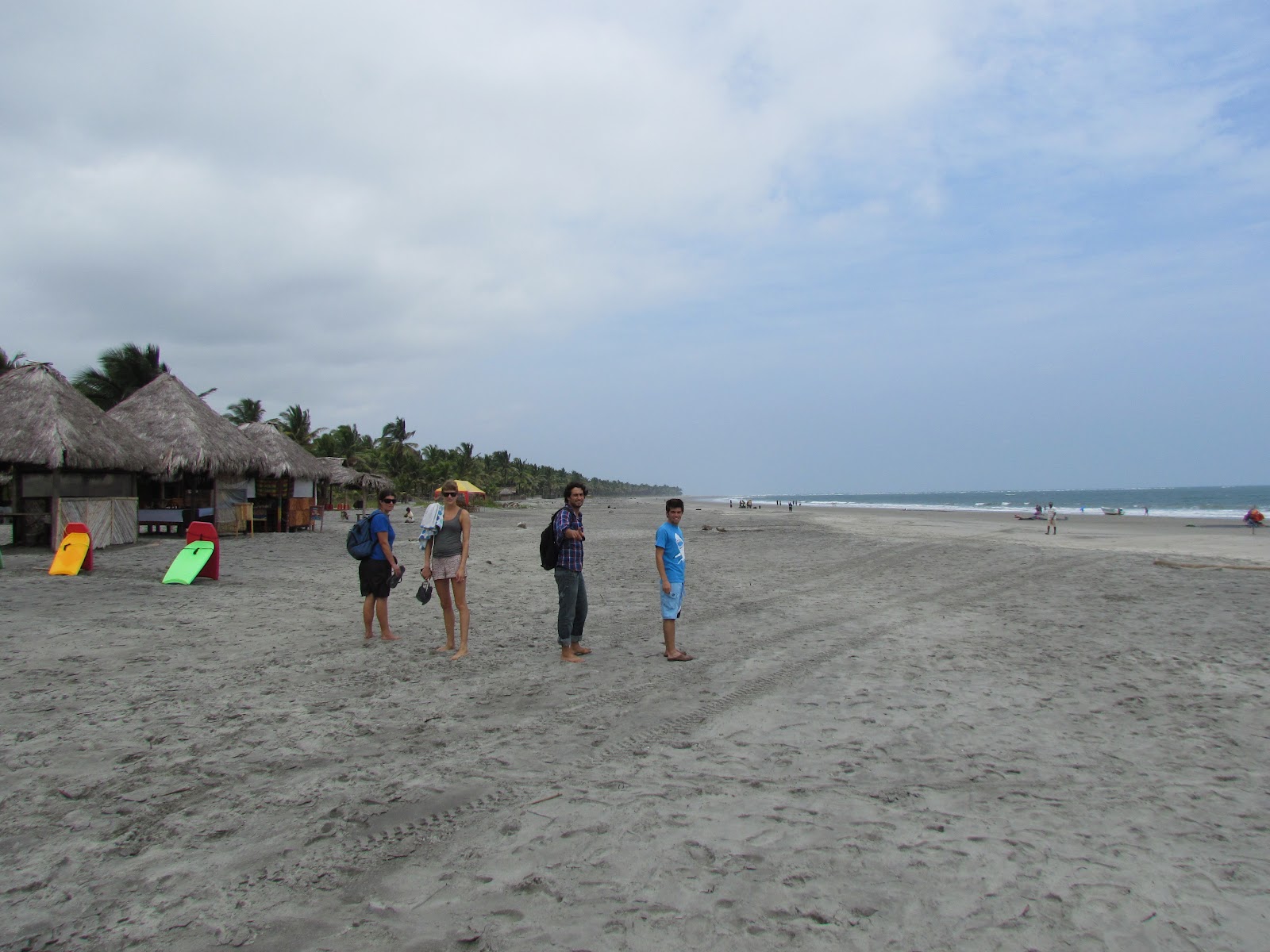
Even though it was the time of year when it's generally cloudy and cooler than the high season, it was still plenty warm enough for us and we ended up spending 6 nights there.  It was a great place to chill out and eat cheap, good seafood, and explore.  It was a small village but one thing we noticed and really liked were the way the houses were all built out of bamboo, and were very open.  Only the bedrooms had windows, with the rest of the house being open to the cool sea breeze.  Perfect.  

There was actually a surprising amount of things to do and see in Mompiche.  We walked out to Playa Negra, a beautiful black sand beach that is sadly being reduced in size as they are mining the sand which is rich in titanium.  We've been to a black sand beach in New Zealand, but this sand was unlike anything else.  It was so fine and soft it felt like silk when we'd rub our sand covered feet together.  Incredible.  

Playa Negra


We also went across to Portete Island, accessible only by small boat, which used to be a well-kept secret but is now well-known amongst locals and travellers.  And unfortunately there's now a huge ugly eyesore on the hillside in the form of an all-inclusive resort complex.  The rest of the island is pretty tranquil and unspoilt though, with miles and miles of sandy beach and thousands of bright orange crabs scuttling all over the show.  Apart from some food and arts/craft stalls, there are no other services on the island.  We also walked along the beach back in Mompiche and up to the headland where a small local cemetery is located, and it was a beautiful view back along the beach.  A very calm, peaceful place.  

Portete Island


View from the cemetery


However, our most unsuccessful outing was to try and spot monkeys in the forest area just a short walk from the beach.  We'd been told by a German guy that once we reached the forest it was only about a 1km walk and to look out for a big tree.  Thanks for narrowing it down mate, it's a forest and there are lots of big trees.  We figured we'd just keep walking and hopefully find, or at least hear, the monkeys, but it wasn't the easiest walk.  It started out muddy and slippery then we had to constantly wade through a river and over slippery rocks.  Not the easiest terrain in jandals/thongs, especially when Kurt's kept blowing out every 2 minutes.  It was also pissing down for a while, but that was actually quite nice.  But after about an hour of walking we figured there would be no monkey watching that day, so we headed back. 


After 6 nights in Mompiche we made the long drive back to Quito, which took us about 9 hours.  Pepe needed an oil and filter change along the way, but did well to get us back over the Andes and to the cold heights of the capital.  We'd had a great 3 weeks cruising up the Ecuadorian coast, eating good food and drinking plenty and meeting great people.  Thanks to Anna, Aaron and Pepe for letting us travel with them - hopefully we'll meet up again soon.

Monday, 20 August 2012

More bang for your buck in Baños

Before arriving in Ecuador we knew sweet fuck all about the country, and we hadn't met many people who'd been there.  In fact, it's a country a lot of backpackers seem to skip over for some reason in their haste to get to Colombia or Peru (depending on which way they're travelling).  The only places we knew about in Ecuador were the Galapagos Islands of course, and a small town called Baños that Kurt knew of and we heard about along the way.  So after getting back from the Galapagos Islands we wanted to check out Baños and see for ourselves what it had to offer.  A shitload as it turns out.

Baños (full name Baños de Agua Santa) is a small city in the Andean highlands, about 3.5 hours south of Quito.  It's located right on the foothills of Tungurahua volcano, which is still active, so it's pretty damn impressive scenery. Baños, meaning 'baths' in Spanish, is named after the hydrothermal springs which surround the city, but this is only one of many things that attract so many people to this city.  And it's not just tourists who flock here but locals as well, as Baños is known as the adventure capital of Ecuador.  Bring it on!

We initially thought we'd spend 3 or 4 days in Baños, but there was so much to do and we liked it so much we ended up staying a week.  Our first night there we met up with Pete and Jake again (Americans we met in Quito) who were already in the hostel we checked into, then Sabien (Belgian we also met in Quito) walked in the door.  We knew she was coming but not for another day or two, so of course we all had to go out for a few beers.  Just a few mind you, we can be sensible about these things.  Sometimes. 

After the awesome hostel breakfast the next morning we went for a walk around town to see if we could hire bikes to explore the beautiful Ruta de las Cascadas (Waterfall Route).  We managed to get some pretty decent bikes for $5 each for the whole day, so off we went.  This route is about 18km by bicycle, and there's about a dozen different waterfalls along the way.  However, it's not the easiest or calmest ride, as you spend most of it sharing the road with trucks and cars. Now I'm not sure if we've mentioned it before, but South Americans are crazy drivers.  The minute they get behind the wheel they turn into insane, impatient wannabe Formula 1 drivers with a death wish, and it's highly unlikely most of them even have licenses.  We didn't have any close calls however, so we were able to enjoy the ride.  Except for the pain and exhaustion of a lot of uphill riding that is.  Minor detail. 

Hydroelectric dam


There were good viewpoints the whole way along, so we could stop and check out the waterfalls and valleys.  It was beautiful lush surroundings, but there was more than just looking at stuff to be done.  We came across a couple of ziplining places, one that was the longest offered (1km) and one that you could do tandem, side by side.  There was also a small bridge jump, but we kept going as we were going to leave that for the way back. 


The small, 35m bridge jump
 
We'd arranged to meet Pete and Jake at Manto de la Novia waterfall (the Bride's Veil) which was the last ziplining place. We'd chosen this one because it went across the valley and over two small waterfalls, so we figured it would be the best view while we were racing across a wire hundreds of metres above it.  But because we're super fit athletic types we'd made it there a couple of hours early, so we decided to continue on to the most spectacular waterfall - Pailon del Diablo (the Devil’s Cauldron).  I'm sure Satan was flattered they thought of him when naming such a beautiful place.  We had to park our bikes and walk about 30mins down to the actual waterfall which was pretty cool, a shit tonne of water smashing down on the rocks below.  And there were viewing platforms close enough that we were nice and wet when we left.

Pailon del Diablo


We went back to meet Pete and Jake at the ziplining place then bargained the guy down to $6 each.  How ridiculous is that?  We all got suited up with the safety gear, then Kurt was first to go so he was lifted up into the bands that hold your legs out behind you.  Next minute he was flying off across the valley, camera in hand to capture the ride.  The two guys were next and I was last across.  It was a lot smoother than we were expecting, and not crazy fast, so it wasn't terrifying at all.  Only when you thought about falling to your death on the rocks below if the safety equipment failed.  I bet that's never happened though. 

Manto de la Novia waterfall in the background


After getting over to the other side we jumped in a cable car/gondola back across which was just as fast, if not faster than the ziplining.  It was pretty cool actually, especially since it was completely open and basically just a metal cage.  Good times all round for $6.  We then had to make the ride back to town, but we'd been told to just flag down a passing truck or taxi that would take us and our bikes back for a measly $1.50.  We rode about a quarter of the way then followed this good advice.

There are so many adventure sports and activites to choose from in Baños, but something we'd been wanting to do for a while was white water rafting.  And why not when it's only $25 each, including lunch?  We had to drive about 30-40 minutes out of town to the river, which was about a grade 3, so a good way to start off.  We had 3 young tourism students in our group plus another guy, and because they could all speak English our guide gave all the commands and instructions in English.  We all had turns being up front captaining the boat in pairs, where you'd get a faceful of water everytime we went over a rapid.  So much fun.  I fell backwards overboard at one stage, but managed to keep my feet hooked in so others could pull me back in.  And luckily I didn't let go of my paddle either.  Not a bad effort.  All up we had about an hour or more on the river but it went pretty quick.  It wasn't over the top in terms of rapids, but it was enough to be a lot of fun. 


The one thing we'd been wanting to do more than anything though, was the bridge jump, or bridge swing.  We were initially going to do the one we passed out on the Waterfall Route, but it was pretty small at only 35m high.  And we figured, if you're going to do something, you might as well do it properly.  So we decided to do it off the San Francisco Bridge which is right in town and is 120m high.  And yes, this was crazy cheap too - only $15. 

The San Francisco Bridge we jumped off.

Beautiful view from the bridge.


We rocked up at about 10.30am but the guy was still setting everything up so told us to come back in half an hour.  No-one else was there when we got back so Kurt got fitted out with all the harnesses and safety gear.  And just in case you're wondering, it was actually really safe.  Not that we've got anything to compare it to, but it seemed like it was going to hold us.  The most difficult part was climbing up onto the ledge over the side of the bridge.  When we'd watched people do it the day before there were steps, which made it so easy, but we had to actually climb up the railing which was a bit awkward.  The last thing you really want to be worrying about when you're about to jump off a bridge, is falling off before you even get on the ledge.  But we both managed fine. 


The guy tells you to put your arms out and jump out as far as you can so you don't just flop off and get jerked by the ropes.  Kurt didn't hesitate when the guy counted down, and his jump was really good.  It was obvious from his yelling and cheering that he was having fun, all the way down to the bottom where another guy pulled him in.  Then it was my turn.  When I got up on the ledge I started freaking out and wasn't sure I could go through with it, but when he counted down I thought it's now or never, so I jumped.  Well, I thought I'd jumped out but when we watched the videos that Sabien took for us, I just kind of fell off, so the guy had to flick my feet so I went out in an arc.  It was the biggest adrenaline rush for both of us, and the funnest thing we've done.  We were both on a high for ages after.  Thanks again to Sabien for the awesome videos to capture our crazy stunt.


We also figured that since Baños is named after the many thermal hot springs, we had to check one out.  We went to one in town that we could just walk to, but it was in an awesome location right under a waterfall cascading down a huge mountain.  We chose to go at night when it was cooler and we'd appreciate it more, and for only $3 each it was a bargain.  There were 3 baths of different temperatures - about 36 degrees, 40 degrees and a cold plunge pool.  We started in the 36 degree pool and after a while decided that it was more than hot enough for us.  Most of the people in the hotter one were just sitting around the edge, so it was obviously ridiculously hot.  We didn't feel the need to scorch ourselves in that one, so just chilled in the middle one for an hour or so then cooled off in the plunge pool.  It was a perfect, relaxing end to the day.

View of the waterfall in the distance from our hostel.

The thermal baths were at the base of this waterfall.

The rest of the time in Baños we chilled out and wandered around.  We visited the randomest museum ever, which had everything from statues of Jesus to old costumes and random toys, to stuffed and pickled dead animals.  An interesting way to spend 30mins. 


But the thing that Kurt had been looking forward to for a long time was getting his tattoo done.  He'd wanted it for the last 6 years, so when Sabien told us she was getting a tattoo done by a local guy we went in to check out his work.  Turns out he's an amazing artist, so we kept popping in to follow progess when Sabien was getting hers done.  He did an awesome job of her black and grey gecko, so Kurt talked to him about his design and booked in for an appointment.  It took a while to get Kurt's idea across to the guy, but after we'd brought in a rough idea of what he wanted it to look like and explained the meaning to him, he got the idea.  When we turned up on the Sunday and he showed Kurt what he'd drawn up, Kurt was so stoked as it was exactly what he wanted.  And just over an hour later, it was done.  His lines were so clean and precise and it looked awesome.  Kurt couldn't have been happier to see the idea that had been in his head for years inked on his skin.  And it only cost $80.  Where else could you get such a quality tattoo, done with perfectly sterile equipment for that cheap? 

Getting started.

The finished product.

Carlos, the talented tattoo artist.

We had so much fun in Baños, it really did live up to it's name of the adventure capital of Ecuador.  For such a small place there's so much to do and see, and we would happily go back for more.